Liminal Spaces in Byzantium and Beyond. Perceptions, performativity, placemaking
International conference
Δημοσιευμένο: 2023-04-05
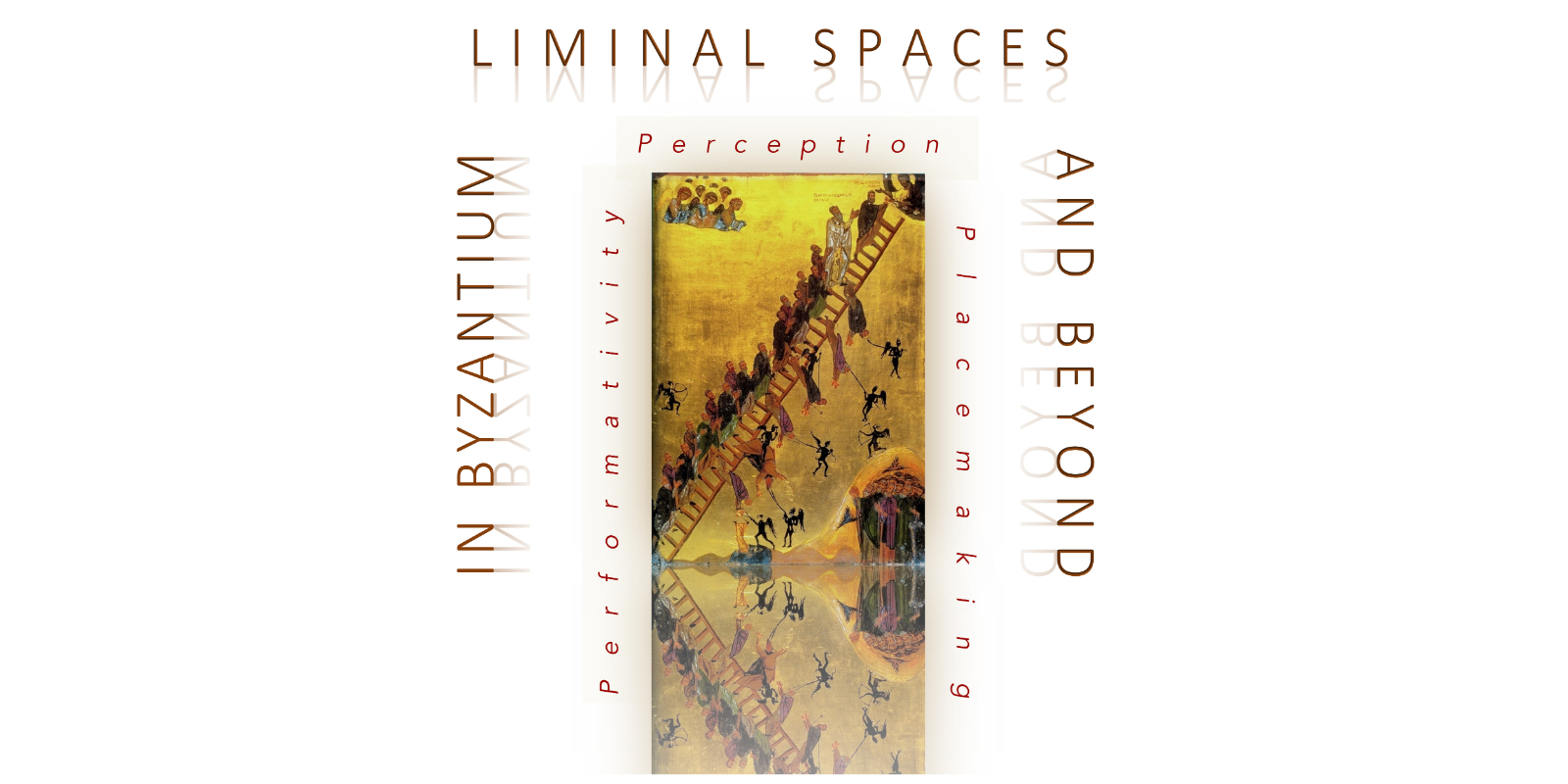
The conference will take place as a hybrid event, Thursday, April 27 – Saturday, April 29, 2023, physically at the Swedish Institute at Athens, Mitseon 9, and digitally on Zoom.
Please register at conferences.sia.gr for participation.
__________
Organizers:
- Prof. Ingela Nilsson (Uppsala University)
- Ass. Prof. Myrto Veikou (University of Patras) & Researcher (Uppsala University)
- Assoc. Prof. Buket Kitapçı Bayrı (Independent Researcher)
__________
Abstract
Since its first conception by Arnold van Gennep in 1909 and its development by Victor Turner in 1950s, the anthropological concept of liminality has travelled to endless areas of study helping to articulate human conditions of and responses to change, and hence developed into a master concept in the wider human, social and political sciences. It has allowed demonstrating that changes in human lives occur through breaking boundaries and experiencing transitory situations and transformative events. These experiences generate in-betweenness, ambivalence, uncertainty, fluidity, hybridity and sometimes existential fear, as well as creativity and renewal which end up producing new and different ‘realities.’ The concept of liminality has both temporal and spatial dimensions. On the personal level, moments such as birth, baptism, passage to adolescence, passage to womanhood, moving, traveling, pilgrimage and conversion and on the social level wars, plague, revolution, invasion and natural disasters can be considered as liminal experiences. Sometimes liminality, which is considered to be a transitionary period can become permanent for individuals and groups such as monks, punks, vagabonds, migrants, and artists.
This meeting concentrates on the concept of liminality in the Byzantine world during which the acts of subversion of territorial and linguistic barriers – through political, military, social and cultural interaction as well as technological, artistic and literary exchange – were very common. Instead of choosing predefined liminal moments/periods or liminal persons, the departure point of the meeting is the spatial dimension of liminality. In specific, the meeting seeks to understand whether certain types of spaces accommodate—or even create—liminal situations according to the eyes of the people experiencing them. It aspires to offer an alternative to the binary oppositions such as inside/outside, self/other, and good/bad and delineate liminality as a pertinent, even necessary concept for understanding a whole series of phenomena placed within the medieval world, and to show connections with our contemporary world so variously characterized by constant change, uncertainty, and institutionalized contingency. It also aims to further develop the use of the concept of ‘space’ as a vehicle for research of the medieval societies and cultures and as working platform for interdisciplinary collaboration within Byzantine and medieval studies.